Everyone's deck looks good the day it's finished.
The difference shows up in year ten — and by then it's the frame underneath, not the boards on top, that decided how things went.
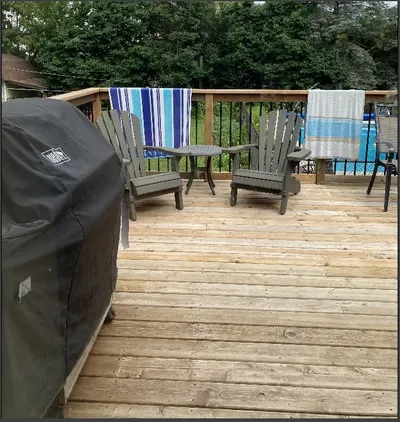
What you're actually paying for
Two decks can look identical and be nothing alike. One is a surface laid over a frame that was sized properly, protected where water collects, and tied to the house so it can't pull away. The other is the same boards over less.
You can't see which one you bought until the weather has had a few years at it. So here's mine, opened up.
The build-up, top to bottom
tap a layer
Six layers. You'll only ever stand on one of them.
Grade / frost line
Layer 01
Decking
The surface takes every bit of sun, rain and boot traffic the deck will ever see. Board choice and how it is fastened decide whether it still sits flat in a decade, or cups and lifts at the ends.
What I use
Cedar or Trex composite, mostly. Cedar goes down in five-quarter boards — the full deck-grade thickness, not thin trim stock. I'll build in pressure-treated if that's what the job calls for; it's not what I'd steer you to.
Where it goes wrong
Boards cup and the edges rise. Usually a moisture problem underneath rather than a fault in the board itself.
Layer 02
Fastening
Every fastener is a hole in the board. How many, where they sit, and whether water can get in behind them adds up over a few hundred of them.
What I use
Confirmed on your visit — I'll walk you through the exact fastening approach for your deck.
Where it goes wrong
Fasteners work loose with seasonal movement, boards start to squeak and lift, and the deck picks up a sway underfoot.
Layer 03
Joist protection
The top edge of every joist sits directly under the gap between boards. Water runs through and stays there. Capping that edge is cheap while the frame is open, and impossible afterwards.
What I use
Joist tape. The top of every joist gets capped before a board goes down, so the water that runs between the boards never sits in the wood or the screw holes.
Where it goes wrong
Joist tops soften and rot from above while the boards on top still look perfectly fine. The frame goes before the surface does.
Layer 04
Frame
Spacing and span are where a deck is quietly made cheap. Push the numbers and the deck feels bouncy from day one — and it will not get firmer with age.
What I use
The frame goes together on dedicated structural hardware — hangers and connectors made for the job, not improvised fastening.
Where it goes wrong
Bounce underfoot, and over time joists take a permanent sag between supports.
Layer 05
House connection
The join between deck and house is the single highest-risk detail on the whole build. It has to carry load and shed water, and getting it wrong damages the house as well as the deck.
What I use
Depends on the deck. Attached to the house, it hangs on a ledger board — and the ledger gets flashed, so water sheds away instead of sitting against the house. Free-standing, the deck carries itself on its own frame and never touches the house at all.
Where it goes wrong
Water tracks in behind the ledger. The damage is inside the wall long before anything shows on the deck.
Layer 06
Footings
Everything above rests on these. In this climate the ground moves every winter, and a footing that stops short of the frost line moves with it.
What I use
Poured concrete footings, formed in sonotubes.
Where it goes wrong
Frost lifts the footings a little each winter. The deck goes out of level, doors bind, and the whole frame racks slowly out of square.
Decks don't usually fail at the boards. They fail at the joints.
What gives out first
- Where the deck meets the house, if water was never given somewhere to go
- Joist tops, holding moisture under the boards year after year
- Footings that weren't taken below the frost line, lifting a little each winter
- Fasteners working loose until the whole thing has a sway to it
What I do about it
- Flash the ledger — or skip the ledger entirely and build it free-standing
- Tape on every joist top
- Poured concrete footings, formed in sonotubes
- Confirm the fastening approach with you on the visit
Choosing boards
I'll tell you the downside of each one, including the one you're leaning toward.
Every board here is a fine choice for someone. The honest part is which someone.
Cedar
Suits you if
You want real wood underfoot — the grain, the smell, the way it ages.
The catch
It asks for upkeep. Left alone it goes grey, and it wants refinishing to stay looking new.
Trex (composite)
Suits you if
You want the low-upkeep surface — no staining, no refinishing, ever.
The catch
It costs more up front, and it's never going to feel like real wood, because it isn't.
Pressure-treated
Suits you if
The budget is the deciding factor and you want the deck this year.
The catch
I'll build it, but it's not what I'd steer you to — and I'll tell you why on the visit.
What a deck from me includes
The drawing first
You see the size, the layout and the number before anything is cut.
Stairs and railings
Part of the deck, not an add-on trade. Built with the same frame discipline as the rest of it.
Permits
Confirmed with you before the build starts.
Delivery and haul
Van and trailer are mine. Materials arrive and the old deck leaves.
One trade throughout
Same person who quoted it is the person building it.
“The time goes into the parts you don't see. You keep them anyway.”
Start with the visit.
I'll come look at the spot, tell you what it needs, and you'll know more about your own yard either way. No charge, no obligation.